
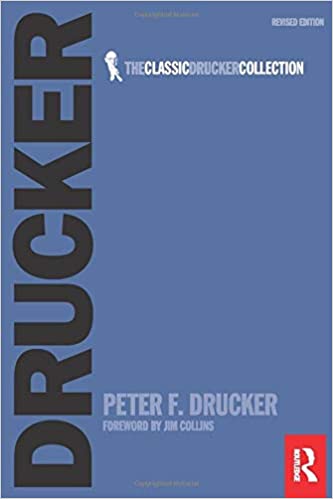
The Effective Executive
Although dated, it contains some of the best writing on personal productivity, time management and decision making I've yet come across. Can be dry in places, though.
Preface
- You can’t necessarily always manage others, but you are able to manage yourself. This is the core concept underlying the rest of the book.
- Additionally, the better question to ask is not ‘what can I achieve?’ but ‘what can I contribute?’ This is more solid and actionable - ‘achievement’ is more nebulous.
1. Effectiveness Can Be Learned
- Effectiveness is not just getting things done, but getting the right things done. It is not connected to our intelligence, or our creativity or our knowledge. The most effective people are often those that others call ‘plodders’ - they plod along, doggedly getting the right things done - day in, day out.
- Just doing the right thing to be efficient is manual work, whereas ‘knowledge work’ is doing the right things.
- Busywork is seldom, if ever, good work worth doing.
- The main value and use of a ‘knowledge worker’ is thinking. The output you produce from all that thinking must be the useful and valuable input for someone else - something that they can then turn, fruitfully, into their own output.
- Knowledge work is defined by its results. What does it actually achieve?
- The less an organisation has to do to produce its results, the better it does its job.
- Important external events are not the trends, but the change in trends. How we go about assessing the changing of trends is crucial to success.
- ‘One of the weaknesses of young, highly educated people today - whether in business, medicine or government - is that they are satisfied to be versed in one narrow speciality and effect a contempt for other areas.’ p19
- There is no such thing as an ’effective personality’ - it takes all sorts, from all walks of life. Effectiveness can be learned, effectiveness is made up of repeated practices that we do day in, day out.
- Becoming effective is not dissimilar to doing your times tables or playing your scales when you learn piano. They are habits that must be drilled.
- There are 5 elements of effectiveness:
- Know where your time goes, and what it goes towards
- Focus on outward contribution - prioritise the results, not the work
- Build on strengths, do not try to shore up weaknesses
- Prioritise areas that will produce the best results
- Make effective decisions - few, but fundamental
2. Know Your Time
- ‘Planning’ rarely ever works in practice.
- Of all the three main expenses in business: people, capital and time - time is the only one that can’t be increased. You cannot buy more of it.
- Time-wasting activities abound in life, so cut them out for long periods of time. Ideally, 5-6 hours in solitude to work at something when required. Wrestle with the problem you have until you’ve made progress on it. The zero draft, or the outline strategy, or the sketch you need. Then the work can continue in small pieces if necessary, but you need to crack the main part of it first.
- True innovation, change and work require large amounts of time for consideration and deep work. ‘All one can think and do in a short time is to think what one already knows and do as one has already done.’ p33
- Most people, most of the time, are time wasters. If you’re going to spend time with anyone, make it count.
- Difficult decisions require large chunks of time to consider properly - they cannot be done piecemeal over the course of days. They must generally be done in one initial concentration of time.
- Considerations about one’s time to make:
- What can I just completely stop doing?
- Can I get someone else to do this? (This is NOT delegation - rather, what more could others be doing in their jobs? Someone who is better at this particular task than I am?)
- Can I stop wasting the time of others? (Calling long meetings, asking for updates, etc…)
- Am I using, sending out, or gathering the wrong information?
3. What Can I Contribute?
- ‘The effective executive focuses on contribution. [They] look up from [their] work and outward toward goals. [They] ask: What can I contribute that will significantly affect the performance and the result of the institution I serve?’ Here, we could just as easily replace ‘institution’ with audience, or clients, or just ‘people’.
- Too many people focus on the effort they are making, not the results they are getting. ()This is where we get the phenomenon of ‘writing at’ versus ‘writing for’.
- People adjust to the level of the demands put upon them. Or: we adjust to the level of the demands we put upon ourselves.
- We need to focus on who it is we are contributing to and then ask what results we are providing to them. Focus on contributing lets us know what is actually important and it cuts out a lot of the noise.
- ‘What can I and no one else do which, if done really well, would make a real difference to [insert here].’ p56 (my brackets)
- ‘The only meaningful definition of a ‘generalist’ is a specialist who can relate his own small area to the universe of knowledge.’ p60
4. Making Strength Productive
- You cannot build on weakness. You can - must - build on strength.
- Narrow but great strength, applied correctly and consistently, beats generalists every time.
- ‘Strong people always have strong weaknesses, too. Where there are peaks, there are valleys. And no one is strong in many areas. … There is no such thing as a ‘good individual’. Good for what? That is the question.’ p68
- ‘Effective executives never ask ‘How does he get along with me?’ Their question is: ‘What does he contribute?’ Their question is never: ‘What can a man not do?’ Their question is always: ‘What can he do uncommonly well?’ In staffing they look for excellence in one major area, and not for performance that gets by all round.’ p69
- ‘Human excellence can only be achieved in one area, or at the most in very few.’ p70
- You can never just hire a hand - a whole person has to come with it!
- On hiring into jobs:
- Guard against ’the impossible job’ - make sure it is will designed.
- Make jobs demanding and big. Give challenge with a wide scope.
- Start with what a recruit can do - not what the job requires.
- Put up with weakness. We have staffed for strength.
- All one can and should ever measure is performance. Anything else is nonsense. Remove those who do not perform - they corrupt the others and weaken the whole organisation.
- ‘By themselves, character and integrity do not accomplish anything. But their absence faults everything else.’ p82
- On firing those who are wrong for the job/who do not perform: ‘‘All that matters,’ he pointed out, ‘is that you know that this man is not equal to the task. Where his replacement comes from is the next question.’’ p84
- Drucker makes the argument against what Seth Godin later describes as a ’linchpin’ in an organisation - for someone to be ‘indispensible’ is to have either a weak superior, or a weak subordinate, or both.
- ‘There is nothing so conducive to success as a rapidly promoted and successful superior!’ p87
- On knowing what to do - at work, in life - ask what you are effective at and can do with ease that others find relatively hard? Do that.
- Feed the opportunity, starve the problem.
5. First Things First
- Do first things first, and do them one at a time. ‘Effective executives do not race. They set an easy pace but keep going steadily.’ p97
- ‘This is the secret of those people who ‘do so many things’ and apparently so many difficult things. They do only one at a time. As a result, they need much less time in the end than the rest of us.’ p97
- The people that get nothing done often work a great deal harder than those who do very many things. This is more to do with the allocation and focus of that effort.
- ‘The executive who wants to be effective and who wants his organisation to be effective always polices all programmes, all activities, all tasks. He always asks: ‘Is this still worth doing?’ And if it isn’t, he gets rid of it so as to be able to concentrate on the few tasks that, if done with excellence, will really make a difference in the results of his own job and in the performance of his organisation.’ p100
- Before starting any new activity, figure out how to offload an old one.
- There is little room for creativity if you don’t prune the old, dead wood of yesterday. ‘Systematic sloughing off of the old is the one and only way to force the new. There is no lack of ideas in any organisation I know. ‘Creativity’ is not our problem. But few organisations ever get going on their own good ideas. Everybody is much too busy on the tasks of yesterday.’ p101
- It’s important to know what not to do as much as it is to know what to do. That is, to choose your ‘posteriorities’ as much as your priorities.
- When you postpone, you actually abandon.
- You cannot realistically have a ’list of priorities’ and then do things piece by piece, that’s the way that nothing gets done.
- As for knowing what’s important, what should be a priority, it’s more a question of courage rather than analysis:
- Future > Past
- Opportunity > Problem
- Our direction > Bandwagon
- Ambition > Safety
- To be truly effective, do not commit to more than one priority. When it is done - when the goal is reached - review how it went and pick another priority.
6. Elements of Effective Decision Making
- Decisions are systematic and should be, as a rule, only made infrequently
- A decision has to turn into work to be effective. This takes time to happen. If it doesn’t, it was never really a decision. ‘In fact, no decision has been made unless carrying it out in specific steps has become someone’s work assignment and responsibility. Until then, there are only good intentions.’ p127
- ‘Even today, few understand that research, to be effective, has to be ‘disorgnised, the creator of a different future and the enemy of today’.’ p109
- The elements of the decision-process:
- Knowing that something is a generic problem, not an exception
- ‘Boundary conditions’ known and understood
- Understanding what the right answer is first, rather than what all the possible adaptions that are required
- Building the action into the decision
- Knowing where the feedback is coming from
- On living with a decision made: ‘‘If I had to live with this for a long time, would I be willing to?’ And if the answer is ‘No’ [we keep] on working to find a more general, a more conceptual, a more comprehensive solution - one which establishes the right principle.’ p121
7. Effective Decisions
- ‘A decision is a judgment. It is a choice between alternatives. It is rarely a choice between right and wrong. It is at best a choice between ‘almost right’ and ‘probably wrong’ - but much more often a choice between two courses of action neither of which is provably more nearly right, than the other.’ p134
- Good decisions start with opinions and hypotheses, not facts. To determine what is a fact first requires a decision on the criteria of relevance.
- Dissent and disagreement is better than consensus. With the former, we are able to see the issue from all angles to enable a solid decision.
- ‘Alfred P Sloan is reported to have said at a meeting of one of his top committees: ‘Gentlemen, I take it we are all in agreement on the decision here.’ Everyone around the table nodded assent. ‘Then,’ continued Mr Sloan, ‘I propose we postpone further discussion of this matter until our next meeting to give ourselves time to develop disagreement and perhaps gain some understanding of what the decision is all about.’ p139
- We should act/decide if:
- The benefits outweigh the risk/cost
- We are committed to action. Do not hedge.